Tuesday, August 21, 2018

2018 Nevada motorcycle trip

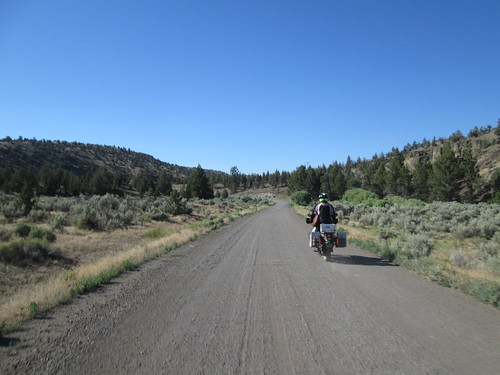
Continuing our 1st dirt road of the trip 

In the last two weeks of July, we went on our annual two-week motorcycle trip. This time, we toured Nevada, as well as parts of Oregon and a wee bit of California. We spent 13 days, going over 2657 miles / 4276 kilometers. We stayed at the historic hotel in French Glen, Oregon, rode around Steens Mountain, rode most of US Highway 50 in Nevada (the "loneliest road in the USA"), visited Eureka, Ely, Rachel and Tonopah, Nevada, stayed two nights in Great Basin National Park, stayed a night in Cathedral Gorge State Park and took the Extraterrestrial Highway.

You can read the travelogue or go straight to the photos.

As always, my goal isn't so much hey, look what I did! as it is here's advice if you want to do something similar.

Saturday, August 18, 2018

Milestone

As of this week, I have lived in the town where I live in Oregon longer than any one, single place, since I moved from Kentucky. The previous record was Sinzig, Germany - I lived there, in one place, for 4 years and 7 months.

I have already lived in Oregon longer than I lived in any other state, except Kentucky, and longer than I lived in Germany.

And, yet... the town where I live isn't home. Oregon isn't home. It's just where I live.

Part of the reason I feel this way is probably because I have moved so often since I left for university when I was 18. After just three years, I start feeling restless. It's not that I enjoy packing and unpacking - I don't, at ALL. I hate it. But I love getting to know a new place, discovering new places to see and new things to do. However, inevitably, I run out of new things to see and do. In addition, I don't seem to be able to find something to keep me tied to a place for long: jobs end, organizations close, volunteering fizzles when a leader changes, friends move, relationships fizzle, people turn out not to be who I thought they were, favorite places close up...

While Texas didn't quite suit me, I never felt like I didn't belong there, that I was unwelcomed there. I never got any attitude from native Texans about not being one myself. And you would think that wouldn't be the case, since no state has as many songs celebrating it as that state does. I love the Lyle Lovett Song That's Right, You're Not From Texas (but Texas Wants You Anyway). It so sums up how I felt there. If it weren't for the heat of the summer and Fall, I would have stayed. I made friends in Austin that are still my friends to this day - though I met all of them because of an online community for a particular kind of music we all love, not just through everyday interactions.

By contrast, in Oregon, if you aren't born here, you aren't wanted here, and those who are born here will say it online and to your face without hesitation. If you moved here from California - oh, heaven forbid you moved here from California. And Oregonians take it further: if you aren't born in the town where you live, they resent any actions you take to influence how things are done in the town: how the police conduct their business, how neighborhoods are defined, how schools are run, whatever. I have never lived in a place where politicians who aren't from a place have to emphasize how many years they have lived here, as if to justify their getting to live here, let alone run for office.

Since moving to Oregon - and particularly since moving to the town where I live in 2013 - I have looked for online communities and offline, onsite groups to join, volunteering, live music venues and arts scenes that would give me what I had in Austin: a feeling of belonging, a feeling of home. I have never made such a deliberate effort to get to know as many neighbors as possible. And nothing has worked out to make me feel like, yes, this is where I love living, this is where I belong. 

Days after moving to Oregon, I felt like I had made a colossal mistake. The state, and Portland, weren't at all what I had envisioned or what people said about them. But after a year of floundering and whining, I decided I was going to be deliberate every day in finding something to like about where I'd chosen to live and deliberate in finding something enjoyable. That deliberation has lasted a full eight years. It's taken work and determination and I'm glad to have done it - I have found some amazing things in this state, including right here in Washington County where I live. Most native Oregonians haven't seen most of what I've seen in their state. I am frequently told by people right here in the town where I live, after telling them about something nearby, "Wow, I never even knew that was there. You know this place better than me." Treating Oregon as a place to explore, just like I do when I'm traveling, has been a great way to approach living here.

But my determination is wearing thin. Once again, as I've done so many, many times in my life, I am wondering, where do I belong? Where is home? That place that feels safe and welcoming and comfortable... that place you go for rest after the travel and adventures - where is my place? Because, after all this time, if it's not here, it never will be.

I still long for that moment of going to a place and thinking, yes, this is where I want to live, for the rest of my life, absolutely. And I know that it is a privilege to be able to choose where you live, one that is denied most people on Earth. So I feel selfish - unbelievably selfish - for feeling this way. But it's how I feel.

I do love my house. I just wish I could move it.

Friday, August 17, 2018

When Father's Hurt, Even Kill, & Their Family Defends Them

Last month, a man in Utah was arrested for domestic violence. Hours after he was released from jail, he flew a small plane into his house. His wife and son escaped the house after the plane crash, but he died.

The day after the incident, I heard a comment from his daughter: "He’s not this person that’s being portrayed."

It's a jaw-dropping, but typical, comment from family and friends of men who attempt to harm or kill a family member or colleague or even a stranger, and it infuriates me.

This man attempted to kill his wife and, very possibly, wanted to kill his son as well. That's not a media portrayal, it's just the facts: the man drove to an airport, he boarded a plane his company owned, he got clearance for takeoff and he flew that plane into his family's home.

I'm always stunned by family members and friends in denial about a person that commits a violent act. It's a denial that results in comments like what his daughter said. Or comments by a woman that is frequently the target of her husband's physical or mental abuse. You don't know him. He's not always like this. He's more than this. This isn't him.

This IS him. A violent family member can be a very nice, supportive person sometimes, even most of the time. Just like a co-worker may be a fantastic colleague, someone you trust absolutely, and later you find out that person subjected another co-worker to sexual harassment. The good times are, indeed, who they are - but the oh-so-bad times are too.

Sometimes, the news hits too close to home. And this is one of those times. I wonder how many family members are silent as they hear this daughter deny her father's violence, who think, This is exactly who he was. But they will never say so...


Sunday, July 15, 2018

Uncle Minnie

My maternal grandmother passed away last year. She was 101. She didn't tell me many stories when I was growing up, in contrast to my paternal grandmother, but she did tell me a few here and there when I was an adult and would visit my hometown every few years. When I was researching my family tree, I interviewed her for information, and at one point in that conversation, she told me about her "Uncle Minnie."

Minnie Howard was the daughter of the sister of my great great grandmother. It was her mother who was my aunt - my great great aunt and, therefore, Uncle Minnie was, in fact, my first cousin thrice removed.  

Uncle Minnie was born in 1896. She lived all of her life in Alabama. And, according to my grandmother, Uncle Minnie was called "Uncle" because she wore men's clothes and dated a woman.

According to the 1930 United States Federal Census, Uncle Minnie was living with her mother in Perry County, Alabama, in a home they owned. She was 34 years old, though the Census form lists her birth year incorrectly. She's listed as the head of the household, as single, and as working as a farmer. The census says she didn't attend school but that she could read and write. At the top of the census form, for everyone listed on that particular form, it says that the "township or other division of county" for where she lived is Scott or Scotts Beat, District 4 in Perry County. There is no Scotts or Scotts Beat listed on any modern maps of Alabama, but after a lot of searching, I found some obituary online for someone I don't know that says "Scott's Beat" is "about eight miles west of Marion."

I never asked more questions about her when my grandmother said why she was called "Uncle Minnie" because I was so shocked that my grandmother was talking about such a thing - my brain completely froze. My grandmother was deeply religious - she was a Baptist and her husband, my grandfather, was a Methodist and after more than 75 years of marriage, on his deathbed, she STILL tried to get him dunked! But there she was, telling me matter-of-factly that my first cousin thrice removed dressed as a man and dated a woman - no judgment, no condemnation. She could have been telling me her hair was blond and had a mule named Daisy.

I like to imagine Uncle Minnie at 30 or so, in a formal men's suit, hair slicked back, looking like Marlene Dietrich. Maybe she's wearing a beret. Elegant. Mysterious. But the reality is that, as a farmer in very rural Alabama, she was probably in denim overalls and boots most of the time, not at all elegant, maybe even being perceived as a man by people who saw her and didn't know her. Further contributing to the denim overalls and boots theory is that she died February 14, 1971, gored to death by a cow that she was trying to separate from a calf. The article says she was "one of the largest cotton and cattle farmers in this part of the state, operating a farm of almost a thousand acres, partly in Hale County and the remainder in Perry." 

Uncle Minnie died at 65. She's buried at Mount Hermon United Methodist Church Cemetery in Mount Hermon, Hale County, Alabama.

With no legal spouse and no children, I'm afraid she's going to be lost to history - as most of us are. But I don't want her to be. Even if she didn't look like Marlene Dietrich.

Thursday, July 12, 2018

Studying Ancestors: getting beyond birth dates and grave sites

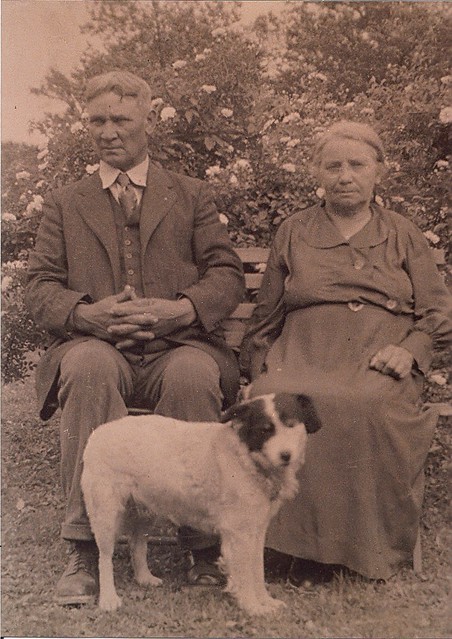
Beasleys of Western KentuckyIn September 1908, at 30 years old, in rural Kentucky, my great-grandmother had her first child, a son, Walter. He was born on the 8th and died on the 12th. I don't know why he died.

In early August 1909, my great-grandmother had her second child, also a son. She named him Otto, after a friend of the family. A year later, in late October, she strapped little Otto to her back so she could work in the fields. And sometime later, she took little Otto off her back, and he was dead.

I don't know if she and my great-grandfather were still sharecroppers then when Otto died or if by then they had their own farm, but I know that she had to work, just as millions of women before her and after her have had to work. She had no choice but to strap that baby to her back and go into the fields. The horror of that moment is not something I think I could have survived. She did survive it. She had nine more children, eight of whom survived infancy, including my paternal grandmother. She had her last child at 44.

I knew my great-grandmother - I was 10 when she died. To me, she was a quiet, sober woman who I never saw smile or laugh. I'm not sure she ever said a word to me. I admit to being afraid of her, sitting in silence, speaking only to fuss at my beloved great-grandfather who was constantly joking and making fun for his great-grandchildren. She was very frail by the time I knew her, and my grandmother, her daughter, directed me to brush her hair once. I stood behind her wheelchair, brushing that long, long gray hair, terrified I'd hurt her. It was only after she was gone that I learned of the story of Otto and the other two children - Walter and Edgar - that died so young. Her father died when she was just 6 years old, and as I understand it, she had to leave home quite young to work for some other family. She then moved to Henderson, Kentucky, more than 60 miles away, to work for another family. She married so late in life - what hardships did she experience before then, being a single woman in her teens and 20s working as a servant? She lost three babies, she had to feed her family when the Depression hit, and she struggled with a paralysis that left her wheelchair-bound for more than half her life - she lived to 98. No wonder she never smiled.

I don't fantasize about the past in the USA, or anywhere else, as some kind of idyllic, magical time. I think about all the children that died like my infant great Uncle. Or from filthy water. Or from malnutrition. I think about girls and women who never even had time to dream because they were too busy trying to survive. Poverty isn't some simpler lifestyle where life was easier: poverty is death in infancy, death in childbirth, death in the fields, death in a mine. It's lack of choices, lack of even time for imagining anything better. As I drove through rural Afghanistan in 2007, where people worked in fields and with animals under a very, very hot sun, a fellow aid worker remarked how beautiful the lifestyle was, how it was a shame to bring them aid and development if it meant they would have to give up their beautiful, simple life. I almost threw him out of the SUV.

I think about my great-grandparents and the various women I've tried to help as a humanitarian worker at least once a day, usually when I'm running the kitchen faucet to cook, or when I'm camping and I'm walking with a container to a communal faucet or pump. I make no apologies for wanting every person in the world to have that access, and nor any apologies for not mourning the "simple" life we'll lose if that happens. Good riddance.


Monday, July 9, 2018

Rethinking "indigenous" & DNA results

When Ancestry.com said that most of my DNA was a match with the people of Scotland and Ireland, I was thrilled! These are countries I love very much. I love their folk music in particular - yes, even bagpipes. I've spent a few weeks in each place and, in particular, I have loved visiting the megalithic cairns and stone circles of the regions. I don't think these neolithic stone structures are magical, but I do think they are amazing: ancient people trying to figure out the timing of the seasons, trying to predict the weather and, perhaps, harness the power of nature and the stars. I thought, wow, the next time I see those stone circles in Kilmartin, I'm going to relish that my ancestors were involved in building them!

Welp, not so fast. Not only because DNA tests are wildly misinterpreted and inaccurate with regards to what we think they are telling us (more on that later), but also because the people I'm descended from did not build those cairns and stone circles.

It was brown-eyed, brown-haired people with faces that are similar to those in Italy or Tunisia or the Middle East that built the stone monuments you see in Irish tourism ads. The genetic profile of these early Irish settlers indisputably originates in the Middle East. Their closest modern relatives — genetically — are the inhabitants of the Italian island of Sardinia. Nearly all of their tools and implements were made from natural products like stone and wood. They were farmers and they were lactose intolerant - they could not drink milk into adulthood without a lot of indigestive discomfort.

However, their DNA is almost entirely absent from the population of modern Ireland and Scotland - this absence indicates that at some point, these people, these stone circle builders, lost out to a new and very different population. In fact, they disappeared from most of Europe, except for Sardinia. For some reason, the descendants of those early Neolithic farmers were left undisturbed on Sardinia.

The DNA of the people that replaced these stone circle builders, the DNA held by the people we call Irish and Scottish today, appears to have originated in the steppes of what is now Ukraine and southern Russia. These newcomers had lactase persistence - they could drink milk into adulthood (as can I - looooove milk).

The genetic record indicates that the local population of stone circle builders was killed rather than that they integrated with the invaders - that may have been a result of war or a result of diseases brought by the newcomers for which the locals had no natural immunity. We may never know.

Here is the article from PRI that explains more. And here is a BBC article that explains it as well.

I still love those cairns and stone circles of Scotland, Ireland, Northern France and parts of England. I wanted so much to be descended from the creators of those. But I'm not - and neither are most of the people of Scotland and Ireland now.

And that brings me to another point: DNA tests. They are a lot of fun, they are based on science, but they are also subject to human interpretation, and I've been just as guilty of misinterpreting what they say as anyone. DNA tests do NOT tell you where your DNA comes from in the past - the tests tell you where on Earth your DNA is from TODAY.

My DNA results say my closest DNA matches are to the people of Ireland and Scotland NOW - not the people of Neolithic times that built those stone circles.

DNA testing companies chose a small number of people in a region to identify as their baseline genetic markers. That means that if there’s only a small number of, say, Central-Eastern African DNA samples that your DNA has been matched against, it’s less likely you’ll get a strong Central-Eastern African match, even if, in fact, you have ancestors from that region. That means that, in fact, you could be American Indian even if your DNA results don't say so.

And with all that said... I wonder... What is heritage? What is my heritage? What isn't my heritage? Is it only through being a direct descendant of a culture that I get to call that culture "mine", or does that kind of ownership or affiliation come from being brought up in that culture?

I don't know.

Other blogs on heritage, culture and who we think we are:

Ethnic, cultural, gender identity - good luck with your definitions

What does it mean to be "white" in the USA?

What is Southern heritage? What is worth celebrating?

Tuesday, June 26, 2018

Calls for civility

We call lunch counter protests civil disobedience, but they weren't seen at all as civil by most white Southerners - and probably most Whites in the North. They were seen as provocative, mean-spirited - as attacks. Same for the marches in the 1960s - most of which were illegal and all of which blocked traffic and disrupted the day of many people - they were peaceful, but they also were infuriating to many. I remember the amazingly provocative but peaceful acts by Queer Nation - we called them civil disobedience because they weren't violent (though the response often was), but they were LOUD, they were disruptive, they pissed people off - and they were key in changing how LGBTQ people were treated (still so, so far to go).

Peaceful means free of violence - but it doesn't mean polite, it doesn't mean not-provocative, it doesn't mean quite and polite.

I also want to note that when Christian terrorists were bombing clinics and shooting doctors and other clinic staff back in the 1980s and 1990s, there was no level of outcry against the violence that came anywhere close to the loud, constant pleas of politicians for reproductive rights advocates to "compromise" so that these terrorists wouldn't be "provoked" to violence.

And so, dearest Trump administration: the non-violent disruptions of your enjoyment of cafes and movies shall continue.

And for those who feel uncomfortable to observe this: good.