Thursday, September 23, 2021

Hope & Mystery with Lucinda the Dog

two dogs greet a man, framed in a doorway

Several of you have asked for a Lucinda update, so here it is. 

Monday was a month since her episode of paralysis. Since then, she's had no more. She's joined Kobe dog on short walks each evening more than a week ago. Yesterday morning, she joined Kobe for a short morning walk too. She was positively bouncy last weekend - her old self. And because, four weeks ago, I was convinced I might not even have her going into October, I'm so unbelievably hopeful and grateful. 

But cautious. 

Her lack of paralysis in the last four weeks has greatly confused the vets, and as a result, they can't answer the question I want most answered: does Lucy have Degenerative Myelopath (DM), in which case she has a fatal disease, or does she have Intervertebral Disk Disease (IVDD), in which case she has an injury that may heal through limited physical activity (or may need surgery eventually)?   

Right now, we're leaning towards IVDD. But we could be wrong. Really, only time will tell, because we can't afford a $4000 (or more!) MRI. 

Here's why she might have IVDD instead of DM:

  • No paralysis in a month. If she had DM, she should have had another paralysis episode by now.
     
  • The paralysis happened less than 48 hours after she had played with Bishop, a full-grown 70 pound or so puppy. He's about a year old, and he and Lucinda love each other beyond words. Bishop has never, ever been aggressive with her or tried to mount her. Most of their play is intense romping bitey face. But the romps are intense, with some body crashes during zoomies, and Lucy is ready for a rest long before Bishop. It's unusual for paralysis to show up so long after the fact, but it is possible. 
     
  • She wouldn't lay completely on her side for most of the first two weeks. She would lay in a ball, or lay on her stomach, like a sphinx, but she wouldn't lay on either side and did no rolly pollies on her back. It wasn't clear to people that didn't know her, but it was clear to me: she was uncomfortable. DM is not supposed to cause pain - it causes numbness.  
     
  • More than two weeks ago, she snapped at Kobe dog twice when he barely laid his head on her back. There is no way he hurt her - we've touched her there repeatedly to make sure. But she clearly did not want him to even dare to apply any pressure back there. It reminded me that she's snapped at two or three other dogs in the last year that she didn't know, ones her size or bigger, something she NEVER did in her first six years. I'd written off that change in behavior to pandemic social distancing - I thought I had accidentally taught her not to be friendly to new dogs. But maybe she's been sensitive to her back for a while now.
     
  • Lucinda has always whimpered or yelped at some point when she's chewing her back left paw during a mani pedi. She moves her leg more than her head to do the chewing - she can bring the foot over completely to her mouth. And about once a week, when she is chewing that foot, she'll whimper or yelp. Dogs don't yelp unless they are in a LOT of pain - they will put up with a great deal of discomfort before they ever show signs that something hurts. The emergency vet said the paralysis was worst in her left leg, and you will recall the observation of my regular vet made about her left leg.

Here's why she might have DM instead of IVDD:

  • She recovered from her paralysis in a few hours. That's typical of DM, not IVDD.
     
  • The paralysis happened suddenly - Lucy got up for breakfast and during her meal, was just fine. She laid down in the living room like always - and two hours later, couldn't get up.
     
  • The way her back curved as she tried to use her back legs, and the way she dragged her legs, was textbook DM, according to the emergency vet.
     
  • If it's an injury, it would be so unusual for paralysis to show up so many hours after the supposed injury (in this case, about 40 hours later).

We still haven't done the genetic test to see if she carries the DM gene. I wanted to wait for Stefan to get home to help me (it's a bit complicated) and in this week since he's been back, he's been busy. We'll do that this weekend. 

Lucinda went off all pain meds and muscle relaxants more than two weeks ago. She now plays a little with Kobe for a few minutes each evening, to the point that I recently had to tell her two days ago to back off - SHE was getting too bouncy. The vet said it's up to me how physical I'm going to let her be, though he said not letting her play with dogs her size or bigger was probably a good idea (which breaks my heart, because we love Bishop and her other bouncy buddy, Beauregard, so, so much). 

I've decided I'll keep her on these short morning and evening walks, and I'll try her on her usual, long morning walk towards the end of October - or maybe early November. 

So many people seeing her now are saying, "But she looks fine." And she does. She looks absolutely like her old self. There is nothing at all to indicate there is anything at all wrong with her. But I'd rather be cautious, because if she is injured, I need to make certain not to do anything to make that injury worse. 

Is this a reprieve of months or years? I don't know. IVDD seems like the lesser of the two evils, but the reality is that, if she has IVDD then, eventually, she will have paralysis again. And the idea of her not playing with Bishop or Beauregard makes me tear up - she loves them so, so much. I think she'll be fine to play with much smaller dogs, but only in our backyard. 

We also have to face the reality that, no matter what she has, we're not going to get the years with her we wanted, and that she deserves. Of course, what dog parent does get that?

I will decide October 15th if I'm going to Sweden for my dear friend Alex's wedding in December. Right now, I'm feeling optimistic. 

With each week, we're going to know more about what she can and can't do. For now, I'm reveling in the unexpected joy that she's so happy and comfortable.

Sunday, September 19, 2021

Still trying to be Scottish

Hurrah! Ancestry.com has redone the DNA tests again. The company retests stuff every few years, per better technology and more samples to judge against. And this time, I've gone down from 73% England & Northwestern Europe (a wee slice of the French and Belgium coasts) to 56% (hurrah!), and increased my Scottish ancestry - it's now up to 32%! The rest: Germanic Europe 5%, Ireland 4%, Norway 3%.

map of Europe, graphically showing the previously noted DNA breakdown

graphic display showing I have a lot of ancestors from North Carolina, Virginia, Kentucky, India, Tennesse and Georgia

And the reality is... it doesn't really mean I'm more Scottish than I was last week. The reality is that someone whose grandparents were all Pakistani and who was born in Scotland and is living there now is far, far more Scottish than I am. 

To figure out a person's regional ethnic connections, Ancestry.com - and the other companies - compare your DNA to a reference panel of DNA from groups of people who have they have designated as having "deep roots" in one region - people who have family going back for many, many generations in that specific region. They look at more than 1000 sections of a person's DNA and assign each section to the ethnicity region it looks most like. Then they turn those results into the percentages or estimates we all geek out over. 

As I wrote in Ancestry drama, the blog right after my first revised DNA results, which drastically reduced my percentage of shared DNA with the Irish and Scots: 

the reality is that the people I thought I was descended from in Ireland and Scotland didn't even build all the rock circles there - the people that built those were smaller, darker, and share genetic heritage with the people in Sardinia now - and, sadly, were completely wiped out by the people I thought I was related to.

So even if I were "more" Scottish, I could not gaze upon the incredible rock circles of Kilkenny and believe I had some sort of special DNA connection to the people that built them - instead, I have a special DNA connection to the people that killed all those cairn and rock circle builders. 

Upon seeing the results of the first test, the idea of being associated with the people who have been in Ireland and Scotland for the last several hundred years thrilled me. The idea of being as much Greek and Roman as I was English thrilled me. But, wham, better science with the revised test, and suddenly, I was just English. I was heartbroken. I wrote on Facebook how disappointed I was to be so boring, and an English friend responded: 

But what IS English? We’re a complete mixture. Aside from 2000 years of trade with Europe and beyond, mixing with the Celts, we’ve been invaded by Vikings (Scandinavian), Romans (from anywhere in the Empire from North Africa to the Balkans and Germany to Spain) and the Normans (french people of Nordic origin) so actually you’re still desperately exotic, windswept and interesting!!...

The English are mutts. Truly. 

And now, here I am, with the second revised DNA results, and my Scottish ancestry has shot back up, and I'm thrilled for no good reason. 

The reality is that I'm me, regardless of what my DNA test results say. 

What I'm much more interested in is the names of each of my ancestors that came from across the ocean to North America. I want to know where each was from and where each landed, and I'd love to get some idea of who each was: indentured servant? Criminal? Ain't no royalty or landed gentry in this crew, I can tell you that much. But it's hard - my first foreign relative doesn't show up until a great, great, great grandfather, from Germany. I don't know his name - just his daughter's name, and on the first US Census where she's listed, she's married and says her father was German. Dead End. I've got a lot of dead ends. I come from people who were poor farmers with inconsistent spelling abilities and questionable literacy skills. 

What I'm also much more interested in is trying to find out who my long-dead family is: what did they do to make ends meet? How many children did they have? Where did they live? Did they serve in wars? 

And inevitably, you get to a place in your family where you have to choose between the name given and the actual biological roots - because none of us are without at least one moment in our tree where a biological father is unknown, or a biological father wasn't at all a part of someone's upbringing. None of us are without adoptions, official or unofficial, in our family trees. And I go for what I consider family: them that raised ya and claim ya. I'm much more interested in the connections of family and shared experiences than I am in DNA, ultimately. 

The reality is that I'm me, regardless of what my family names say. 

My previous blogs on the subject of ancestry:

tips for using ancestry.com

Uncle Minnie

Rethinking "indigenous" & DNA results

Ethnic, cultural, gender identity - good luck with your definitions

What is Southern heritage? What is worth celebrating?

Wednesday, September 8, 2021

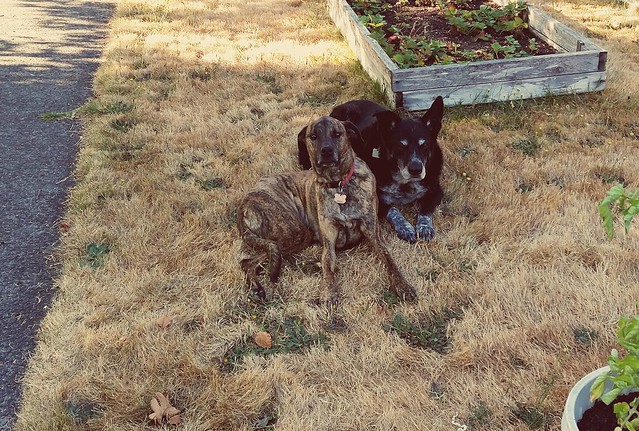
We still love Lucy

Caught in the act of hanging out in the front yard

A week after Lucinda the dog's trip to the emergency vet and her diagnosis of Degenerative Myelopath (DM), she'd had no second episode of paralysis. So I wrote the emergency vet and told her this, told her she seemed fine. I got this from one of the vet techs: 

I am so happy to hear that Lucy is doing well at home. Dr. Schwindt thought that Degenerative Myelopathy was a possibility, but it is more likely that Lucy has that Intervertebral Disc Disease (IVDD). Since she is improving with the medications sent home, IVDD does seem to be the most likely culprit. Dr. Schwindt recommends finishing out the prednisone as prescribed and keeping Lucy on her gabapentin. It is okay to give the lower dose of the muscle relaxant as long as she is continuing to do well. Here is an article with more information about IVDD: 

Intervertebral Disk Disease (IVDD) in Dogs - Veterinary Partner - VIN

My regular vet, Dr. Syd, was booked solid, and according to the online scheduler, I couldn't get her in to see him until October. I schedule the appointment for mid October, then pleaded via email for something earlier. And I got it - for today. And here's the 411 from today:

Dr. Syd thinks it still might be DM, but maybe not - he just can’t tell. He said that it’s very strange, if it’s IVDD, that she was paralyzed for 6 hours a full day after playing with a year old puppers but then got better, but that there certain are cases of dogs being injured while playing and the injury showing up later - he just thinks it’s weird that it got better, if she's injured, that the paralysis did show up later and then got better on its own in just a few hours. 

He curled each of Lucy's feet, and her back left paw didn’t snap back the way it should - it oh-so-slowly uncurled. I could see it so obviously and I gasped at what I saw. The emergency vet also said that her left leg was especially bad during the paralysis. But it did, slowly, curl back into place. It's the most definite sign that something is still very wrong. 

I told him that she'd snapped at a couple of dogs in the last six months, and I'd been shocked, because she NEVER does that. She has snapped at Kobe twice when all he did was walk up to her and put his head over her back shoulder blades - not even on them. But she will let me and any human pet her on her shoulder blades. I had decided the snapping was because she was protective of her back - she knows dogs can be unpredictable. She has NEVER let Bishop, her very best dog buddy ever, do anything on her backside, not even lay his head. They play VERY rough - but she has let him know lately she has an absolute limit (thank goodness that sweet boy takes "no" for an answer).  

Dr. Syd had me walk Lucy outside while he watched, walking her back and forth and in a circle. I, of course, spoke in a high-pitched voice to her as we walked back and forth, making references to Best in Show because, even in a moment of crisis I shall always be a total dork. He watched her and after a whiel, he remarked how she was just as spry and normal as could be and he saw NOTHING wrong. And back in the exam room, when it was time to leave, she did a downward dog.

So he’s as confused as we are. 

He says: let’s wait a month and see. She’s out of all of her meds except the muscle relaxant. He says: no more meds. Not for now. Keep her in this low activity mode, no playing with other dogs, no walking long distances, for 30 days. Maybe after just a week or whenever I think it’s best, I could walk her a bit. And after a month, bring her back to him for another exam. 

He said we should do the genetic test for DM just to eliminate DM as a possibility (and even if she carries the gene, it doesn’t mean she has it). But he said the only way we are going to know absolutely, positively, if it’s an injury that needs surgery is to do an MRI - there is no other way. It’s at least $3000. He had his dog scanned that way, they found the problem disk, he had surgery, and he’s fine now and he says he’s got 5 or so years ahead of him now. Yes, I will pay $3000 if it means I get my girl for 5 or more years. 

But there’s no rush at all for an MRI and there may NEVER be a need, and another month of no surgery, if it’s a disc issue, isn’t going to hurt her. 

So, another month of this low activity. And now, we try with no meds, to see how she does. No playing with Bishop, her very best buddy in the universe, which breaks my heart. No playing with other dogs at all, except Kobe, which is just a lot of posturing for 5 minutes after supper. Otherwise, they just hang out together and talk shit about me. 

I’m going to wait until Stefan is home from his vacation and then we are going to walk her together for a little bit, each Saturday and Sunday.

Time will tell, I hope. 

Tuesday, August 31, 2021

The betrayal of Afghanistan


For six months in 2007, from March through August 2007, I worked in Kabul, Afghanistan, helping a national government ministry there with various communications functions, via a United Nations contract. 

I researched and edited reports for donors, I got our program's vast photo archive of work with Afghans online so other agencies could use them for their reports and online, and I did workshops to help my Afghan women colleagues improve their communication skills.  

It was a time of hope in a surreal setting. It wasn't safe for a foreign woman to walk around on the streets of Kabul, but there were about six restaurants that the UN considered safe enough for staff to go to (and about half a dozen more that staff also went to). I worked primarily with Afghans, in an Afghan workplace, not a UN compound, not surrounded primarily by foreigners. A headscarf could be loose - an unmarried woman could still show her hair beneath that scarf. Not every woman was in a burqa - none of my Afghan co-workers were. I bounced around in a UN SUV on bomb-pocked dirt roads to work at about 6:30 a.m every morning, and went the same way home at about 5 each evening, six days a week. We often passed men playing volleyball in the dusty dirt outside a bombed-out building. I spent most of my days in front of a laptop, writing copy: reports, press releases, video scripts, web site content, etc. Sometimes I was in meetings, sometimes I was walking within our walled ministry compound, trying to track down some Afghan official to interview for a report I was preparing about a dam or a winterization program or some other rural development project. I rarely got moments away from work or my guest house, but I did get a few: a day at a lake, two days in Kandahar, all day in beautiful Panshir, an afternoon in the Kabul history museum near Darul Aman Palace... 

I won't say I loved it. I didn't love it. Some days, I hated it. It was hard, lonely work. I missed my husband and my dog. I missed walking. I hated the polluted air. I was appalled at how dogs were treated (the Koran, by the way, teaches to care for dogs). I was offered an extended contract and said, "No way!" 

But I loved working with Afghans - all these young, educated, hopeful people who went all in to improve their country. Their hope and assumptions about the future were infectious. I took photos of them, I blogged about them, I stayed in touch with them all these years. They went all in to make their country better and to believe their country was embracing Democracy, and they were already living a life oh-so-different than anything the Taliban would ever allow. 

When I left Kabul in August 2007, Lonely Planet had just published a guidebook to the country, I had written and published a guide online to shopping in Kabul, so foreigners could support local businesses, especially women, and I told my husband I would take him to Afghanistan in probably five years, because the country would be safe enough for us to go for a visit. 

All these Afghans who believed they could build a modern country - not like the USA, not like Canada, not like something in Europe - they wanted something like Lebanon in its heyday, or like Egypt at various times in the 20th Century: a modern Islamic state, where the religion was valued and practiced openly but also where women went to school and had careers. They wanted the country to look more like Tajikistan or Uzbekistan. They did NOT want to be "America" - they wanted to be Afghanistan. And they worked towards that. They lived it, every day. And the USA celebrated that, publicized it, bragged about it. 

A few years later, I watched one of my colleagues get a comment on his Facebook page about being Pashto, in contrast to Tajik or whatever, and he responded, "I am Afghan." It warmed my heart. 

And the way my Afghan colleagues have lived in the last 15 or so years, the way the USA and other countries have encouraged them to live, is now going to get them killed. 

Here I am in Oregon, 14 years later. I've spent days and days compiling information and doing online research and writing the state department and my elected officials, trying desperately to get the magical paperwork for my assistant and her family, and another woman I worked with, so they can get out of the country. I'm writing letters, sending emails, posting online, filling out forms... and it just does nothing. I'm also scrubbing photos off the Internet, including photos of me with some representatives from an Afghan media channel when they visited Portland and a blog applauding my alma mater back in Kentucky for honoring an Afghan journalist. 

My former assistant has four young nieces that she's responsible for, and she's terrified the Taliban is going to take them away, because that's what they do. They hide in their house. The US press says, "oh, the Taliban says women will be able to go to school, they will be able to work in separate workplaces!" while the Taliban tells women and girls they must stay in their homes - and far worse. 

I get messages from my assistant each morning and each evening so that I know she's still alive. 

I just can't believe we have abandoned the people who believed in us and have lived the lives they've lead, because we, the USA, the Western World, said, hey, we've got your back, go for it! All these uplifting media TV stories over the years about Afghan women over the years, because they formed a bicycle riding team or a soccer team or a skateboarding club - all of those stories now have the potential to get them killed.

The evacuation did not have to happen this way. Leaving Afghanistan did not have to happen this way. Trump didn't involve the Afghan government in any negotiations with the Taliban, signaling to everyone: they are powerless and meaningless. Same for women: Afghanistan has women leaders, and they were left out of all conversations. The military thought contractors and lots of equipment could create an Afghan army - and they never considered talking to Afghan young people, or any women, about what was happening, they poured money into contractors bank accounts instead of regular people's. Yes, Biden inherited a mess he could not fix, but he has to be held accountable for his role in this disaster of an evacuation, starting with the sudden closing of Bagram airbase, which was such a colossal mistake, and no plan for mass evacuation. The arrogance and denial of Biden and his administration about how things would end in Afghanistan cannot be forgotten: 

The Taliban is not the south—the North Vietnamese army. They're not—they're not remotely comparable in terms of capability. There's going to be no circumstance where you see people being lifted off the roof of a embassy in the—of the United States from Afghanistan. It is not at all comparable. 

Biden during a July 8, 2021 press conference.

And it's going to be sooner rather than later when we start hearing about how the USA is going to give the Taliban money despite their rapes of women and murders of journalists and ethnic minorities - it will be something about "fighting terrorism" and "we can't expect them to change overnight" and blah blah blah. All sorts of excuses. All sorts of empty excuses for not really pressuring Afghanistan in any meaningful way to restore women's human rights. 

Why will any person in another country believe a US military person, a US diplomat, a USAID worker, a Peace Corps member, or any citizen of the US who says, "Hey, trust me! Let's work together! Let's be allies!" Why should they believe the US ever again?

Bases in Germany, Italy, South Korea, Japan... good, long relationships with people in those countries, starting when they were war-ravaged and needed to rebuild and needed that long-term commitment. But not Afghanistan.  

I'm just gutted. I'm completely gutted. And ashamed. 

September 1, 2021 Postscript:

Educated girls grow to become educated women, and educated women will not allow their children to become terrorists. The secret to a peaceful and prosperous Afghanistan is no secret at all: It is educated girls.

Shabana Basij-Rasikh, @sbasijrasikh on Twitter, in "I founded a girls’ school in Afghanistan. Don’t let our stories disappear as they have before."

Monday, August 30, 2021

What our grandparents' ration books say about our social contract

Wise words from my friend Julie. She posted this to Facebook. Paragraph breaks is mine:

A couple of years ago I visited with a dear and amazing cousin who was clearing out the apartment of her mother who had recently passed (a truly incredible woman, but that's a whole other story). Among the keepsakes she was sorting through was a book of rationing coupons from WW II. 

I had heard of these, of course, but never seen or held one until that moment. It was so poignant and powerful to look through them. There were coupons for butter and sugar and other household items; some were missing -- presumably spent by her family back in the day. Of course I was not alive then, but from what I've been told by family members, people proudly participated in the rationing effort. They pulled together in community and sacrificed for the war, denying themselves for the greater good, and feeling a great deal of pride about serving the cause. Many, of course, made the ultimate sacrifice, of their own lives, or those of their children or spouses. My mom lost her father to the war at the tender age of 9, and very nearly lost her oldest brother as well, who was shot down behind enemy lines and barely avoided capture. 

Anyone who knows me knows I'm no blind patriot -- I fully acknowledge that as a country we often fail abysmally to reach the aspirations set forth in our Constitution, and the toxicity embedded in our systems sometimes seems too much to bear or overcome. But something I am mourning right now is the prevalence of a warped belief by a significant minority of Americans that making even small sacrifices for the safety and well-being of our larger community is somehow a personal or patriotic failure, or worse. That wearing a mask, or social distancing, or getting a vaccination is "unAmerican." This is so upside-down. As flawed as being "American" can be, historically there is honestly nothing *more* American than sacrificing for the greater good. We can start with George Washington's requirement during the Revolutionary War that his troops be vaccinated against smallpox, which let me tell you did NOT involve walking into a nice clean Walgreens, having your arm swabbed with alcohol, and getting a quick little jab by a professional with a sterile, safe needle and a vaccine that had been rigorously scientifically tested. It was a dangerous, painful and ugly process and without it we would have lost the Revolutionary War. 

Fast forward to today, when a dear friend picking up take-out from a restaurant had a man attack her and literally threaten to rip the mask off of her face, because "we don't wear masks here." Some folks have been convinced that being selfish and endangering others is patriotic. It makes me so sad. I can't imagine how to heal it.

Monday, August 23, 2021

We love Lucy

I've got some bad news, but first I want to say that Lucinda the dog is comfortable and happy and, as I write, she's laying out in the sun in the backyard, looking very content.

Today, I learned that, very probably, Lucy, our beautiful, gorgeous brindle girl, has Degenerative Myelopathy. Now, I want to emphasize that, right now, she's very comfortable and, as I write this, she's walking just fine, and getting up and down just fine. But that was not the case this morning, and a visit to the emergency vet gave us this diagnosis. And it means our time together is not going to be quite as long as you would expect when your dog is only seven years old. 

Degenerative Myelopathy is a neurodegenerative disease in dogs, and it causes a progressive and irreversible deterioration and loss of function of the nervous system, especially the neurons in the brain. In essence, it “short circuits” nerve pathways from the brain to the limbs so that, over time, the dog loses its ability to feel or use its limbs. 

This could take a year. This could take as much as three years. This could happen in months. It usually happens over six months. We just don't know.

The good news is that DM is not painful, in and of itself, and it can be quite gradual. But there is no cure for this disease and it is fatal. Most owners choose to euthanize their dogs when they can no longer take care of their bodily functions, rather than allowing the disease to progress all the way.

We are, of course, devastated at the news. 

For the next four-eight weeks, we have to deprive Lucinda of what she loves most: walking and interacting with other dogs and all her human friends. We have to see how she's doing and if this was just a first sign of her disease, one that will slowly progress, she's going to get to resume our walks. But no more hiking, since we need to always be ready for the possibility we have to get the car for her. And no more playing with other dogs, at least not the dogs she loves most, because that could risk injury. The vet told me specifically: "no more sprinting." 

I'm now home, having been at the emergency vet for five hours. They saw her almost immediately to make sure she wasn't about to die, then did a more thorough examination three hours later. Stefan had to carry her to put her into the car, and she was gurneyed into the examination room after they tried to walk her through the lobby. For at least three hours at the clinic, she was lethargic, couldn't stand, and her eyes were half-closed, because her brain wouldn't open them wider. And now, she's walking through the house, bright eyed, like it ain't no thang, all medded up and wondering what the fuss is all about. 

Huge shoutout to Tanasbourne Emergency Veterinary for having tables and chairs and big gazebo covers all around the sidewalk of its office. I had had the wherewithal in the panic to bring the dogs' beds, so we were comfortable, in the shade - but I had no food, and my phone had 10% power, so I had to turn it off and use it only to tell Stefan when to come pick us up (he works quite nearby the clinic). It was just me, Lucy, Kobe (our guest dog for the next several weeks), and my thoughts for five hours. Not a good Monday. But I was glad not to have to be in the lobby. We were on the side of the building and left quite alone, and it was nice.

Huge shoutout also to Kobe, who just grooved along with it all, perfectly content, happy to be included. Got in and out of the car on command like he's been doing this with us for years. 

So, I won't be going on that big motorcycle trip in September after all, which is incredibly sad, as it's for Stefan's 50th birthday, and we were so, so looking forward to this. I hope he will still go and enjoy the Colorado dinosaurs without me. But I'm not going anywhere for a while. I've got a Mexican princess to look after. She's now on her bed next to the couch, enjoying the sedatives. I think I'll take some. 

Tuesday, August 24 update: She's fine today, the day after. Walking around like there is nothing wrong at all. We're not crating her, as the doctor suggested, but we are keeping her on the sedatives and not taking her for walks while she's on those meds. And I've reconfirmed I'm not going on our motorcycle trip, which is devastating, but not as devastating as this diagnosis. I'll be very, very sad to miss this trip. I would be shattered if she took a turn for the worse in the three weeks I'm gone. I'll consider it a gift if she's fine for all of September. 

I've learned that "The variable presentation between breeds suggests that there are environmental or other genetic factors responsible for modifying disease expression" from this resource. So her lack of good nutrition in the womb could have, indeed, contributed to how this disease has manifested. "Genetic testing remains the only reliable way to detect neurological disease associated with this mutation prior to death." We're going to get her a genetic test - ordered it today - and if it turns out that it's not DM, then I think the only other thing it could be intervertebral disc disease - which is also lousy. But given her droopy eyes yesterday, in addition to the back legs, I just don't see how it could not be DM.  It's not common in greyhounds, and we are relatively certain that's her dominant breed. In one study of 33 greyhounds tested, 3% had two copies of the mutation and were at-risk. However, maybe her dominant breed is boxer, and if that's the case, in one study of 3934 boxers tested, 29.9% were carriers of the mutation and 57.4% were at-risk/affected. And, no, I'm not getting a genetic test for breed - everything I've read says those are often inaccurate and meaningless - you would have to do tests from at least three different companies to see if they all said the same thing. And, honestly, now, it really doesn't matter. Her breed is Lucinda of Northern Baja, California, Mexico. 

Sunday, August 22, 2021

Happier?

Are callous people happier than me?

Are people that learn that their neighbors need something and can completely ignore helping at all happier than me?

Are people that pass the buck happier than me?

Are people that avoid the news because "it's such a downer," or can watch it and not feel anything - sympathy, compassion, sadness - happier than me?

Are smug people happier than me?

I wonder. I really do. 

Are people who shrug and say, "Not my problem," happier than me?

I wonder.